

Two hundred and fifty years. Three long lifetimes, laid end to end. That’s all that separates you from a sweltering room in Philadelphia where fifty-six men turned themselves into traitors with a pen.
Tomorrow marks 250 years since the Declaration of Independence was adopted. Every man who eventually signed it understood the price of losing. The price was the rope.
We celebrate the opening line. The self-evident truths. Life, liberty, the pursuit of happiness.
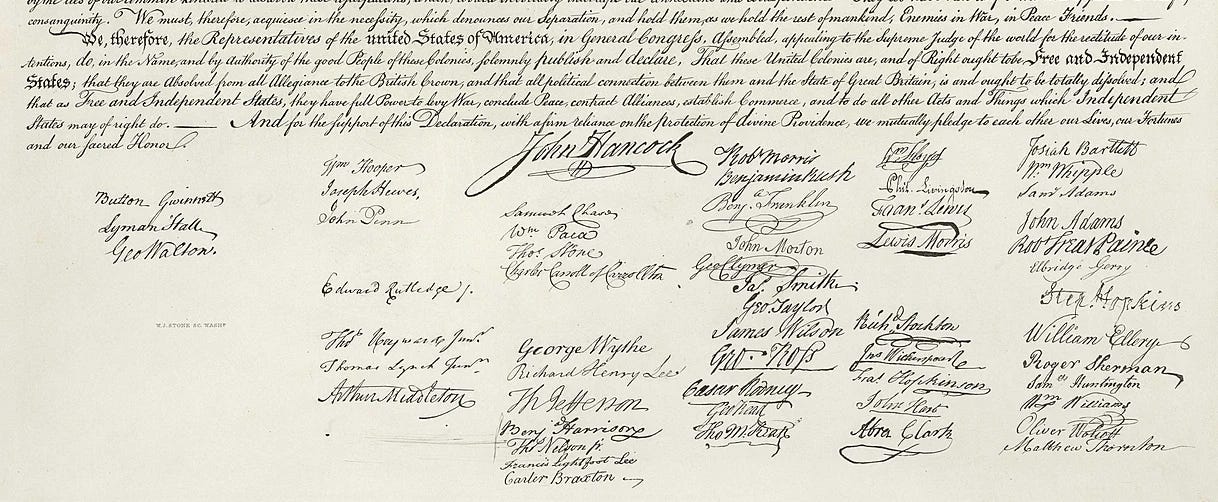
Almost nobody reads the closing one:
“We mutually pledge to each other our Lives, our Fortunes and our sacred Honor.”
That was not a flourish. It was an inventory of what they expected to lose.
They Meant It Literally
The Declaration did not end anything. It started seven years of war, and the men who signed it spent those years finding out what their signatures cost.
Richard Stockton of New Jersey was dragged from his bed at night by loyalists and handed to the British. Prison broke his health, the war took his estate, and he died before it ended. Francis Lewis of New York lost his home to British guns and his wife, Elizabeth, to a captivity that destroyed her health. Thomas Heyward, Edward Rutledge, and Arthur Middleton of South Carolina were captured when Charleston fell and locked in a prison at St. Augustine. Robert Morris spent the war signing his fortune away note by note, keeping Washington’s army supplied on personal credit when Congress had nothing left.
Thomas Nelson Jr. of Virginia borrowed enormous sums on his own credit to keep the army fed and armed. At Yorktown, when British officers made his house their headquarters, he told American gunners to fire on it. His own roof. The war ended. The debts did not. He was never repaid, and he died a poor man.
Then there is John Hart.
He was a New Jersey farmer in his sixties, a man who had spent a lifetime turning dirt into a living. He signed in the summer of 1776. By October, he was burying his wife, Deborah. Weeks later, the British swept into New Jersey, and that signature made him a hunted man.
So he ran. Not to a safe house. Into the woods. A grandfather sleeping in caves and outbuildings while soldiers wrecked his fields, scattered his livestock, and sent his children fleeing to the neighbors.
He came home to a ruined farm and kept serving anyway. A year and a half later, he offered those same fields to Washington’s army, and twelve thousand soldiers camped on them on their way to Monmouth. He died in 1779, four years before the peace he paid for.
Nine of the fifty-six never lived to see the victory.
They Paid for a Dream They Never Saw
Here is the part that stops me cold. Not one of them got to see what you and I see.
They never saw the country cross a continent. They never saw it survive a civil war, feed half the world, or put boots on the moon. They never saw a woman put her own name on a business license and sell the company a decade later.
They bought all of it anyway. Sight unseen. On faith.
Strip away the powdered wigs and the oil paintings and look at what actually happened in that room: the people with the most to lose bet everything they had on a dream they knew they might never touch.
The Noise Is Part of the Deal
Of course we have problems. We are loud about them. We argue in public, we litigate everything, we broadcast every failure in real time. Some days it’s exhausting to watch.
Don’t confuse the noise with the deal.
The world is checking our math right now. Millions of World Cup fans are in American cities this month, many setting foot here for the first time, and their verdict is all over your feed. They came expecting the country they had been warned about. They found free refills, strangers who say good morning, and Scottish fans playing bagpipes down a Boston street at dawn while the neighbors cheered. One British visitor put it plainly: she had always heard Americans were fake, and it wasn’t true. They are packing ranch dressing into their checked luggage to take a piece of this place home.
Two hundred and fifty years of noise, and visitors still walk off the plane into a country better than its reputation.
For most of human history, in most of the world, what you were born into was what you died in. Your father’s trade. Your landlord’s land. Your king’s permission. And in some countries, right now, the rope is still the price of saying so out loud.
Here, you can fail in public on a Friday and start again on Monday. You can put your name on the door. Nobody has to vouch for you, approve of you, or recognize your last name.
The system does not promise you a win. It promises you the attempt.
I built a company from nothing and sold it. In this country, that sentence is unremarkable. That’s the point. Almost anywhere else, in almost any other century, it would be a fantasy.
The dream was never that life here would be easy. The dream is that the pen is in your hand.
The Inheritance
You didn’t sign anything. Neither did I. We were handed a deal that fifty-six people paid for in blood, fortune, and honor, 250 years before most of us bothered to read past the first sentence.
So enjoy the fireworks tomorrow night. Eat too much. Let the kids stay up late.
But at some point this weekend, look at what you have built, or what you have been too afraid to start, and remember that the tab was already paid.
Lives. Fortunes. Sacred honor.
The least we can do is build.
If this resonated, subscribe to The Jenn Files. I write about business, money, resilience, and grit — cutting through the noise so you can build something that can’t be broken.
Prefer to read in the app without the inbox noise? You can switch to app-only notifications in your Substack account settings under Notifications. I want this to work for you however works best.
Sources
The Declaration of Independence transcript and signing history: National Archives (archives.gov/founding-docs). Signer biographies: National Constitution Center (constitutioncenter.org/signers) and the Descendants of the Signers of the Declaration of Independence (dsdi1776.com). Thomas Nelson Jr.: National Park Service (nps.gov). John Hart: Cleon E. Hammond, “John Hart: The Biography of a Signer of the Declaration of Independence” (1977). Treaty of Paris: U.S. State Department, Office of the Historian. World Cup visitor coverage: CNN, ABC News, NPR, and The Hill, June 2026.