Coast
Breakdown doesn’t build you. It shows you what you already built.
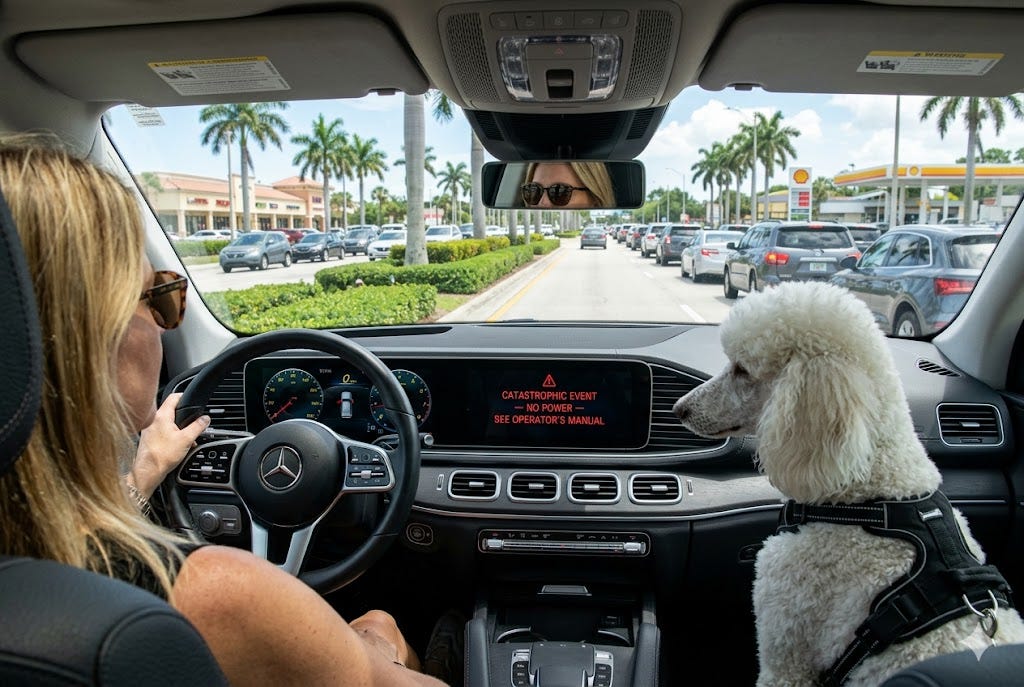
The car died in the left lane.
Three lanes of traffic, everyone moving, and the dash lit up with a warning I’d never seen: catastrophic event, no power, nothing. No engine. No steering assist coming next. Just me, Bella, and a two-ton machine turning into a paperweight at forty miles an hour.
I had maybe four seconds to decide something.
So I decided. I let the momentum carry me, read the gaps, and coasted across three lanes to a side street before the car rolled to a dead stop. Then I sat there. Engine off. AC off. Bella already starting to pant in the Florida heat. And the strange quiet that comes after the thing you feared actually happens.
Here’s what I noticed in that quiet: I wasn’t waiting for anyone.
The car was never the point
Cars aren’t cars anymore. They’re rolling computers — electrical systems wearing sheet metal. When the brain goes, the whole thing goes. This was a 2019 with about 47,000 miles on it. Not old. Not run into the ground. And it still died like the power got cut at the wall, because that is exactly what a modern car does when the electrical system fails. No power meant it wouldn’t shift into any gear at all, which meant a jump wouldn’t save me and I wasn’t rolling it anywhere. I was calling a tow.
I worked the problem in order. Called the shop I trust. They gave me a window: get it there by five and it could sit safely until Tuesday, when they’d be back to run diagnostics. Called my dad, who happened to be in town, and he drove the twenty-five minutes to come sit in it with me. We tried the jumper cables. Nothing. So we stopped guessing and called the tow.
The tow driver didn’t speak any English. He ran everything through Google Translate, phone held up between us, and we figured it out anyway — two people, a broken car, and the universal language of let’s get this done. He’d come to this country about six years ago, lived in Philadelphia, landed in Florida. He showed up. He did the work. That’s the part that matters.
The whole day went from a plan to no plan to a brand-new plan, reassembled on the shoulder of a road in real time.
And the entire time, one thought kept circling back.
Most people would still be sitting in that car, in the left lane of rush-hour traffic, completely broken down.
The thing nobody teaches you
And they wouldn’t be sitting on the shoulder where it’s safe. They’d be sitting dead in a live lane, hazards blinking, hoping the cars behind them figure it out before someone doesn’t.
I never sat in that lane. The move that got me out of it wasn’t luck and it wasn’t time. I had less than four seconds, and in those four seconds I had to do three things at once: decide whether I still had enough momentum to make it, find a gap in three lanes of moving traffic, and thread a dead two-ton car through that gap to a side road that wouldn’t dump me into the middle of the congestion. Decide, calculate, execute. Before the rolling stopped.
That is not a thing you do in the moment. That is a thing you’ve already become before the moment arrives.
To some of us this feels like common sense. It isn’t. It’s a skill set. Somewhere along the line I was equipped. By my parents, by building a company, by years of operations where the plan blows up and you rebuild it on the fly or you sink. I didn’t become calm on Friday because the moment called for it. I was calm because I’d already built the person who doesn’t freeze. The car just showed me she was still in there.
That’s the uncomfortable truth about breakdown. It doesn’t build your character. It exposes it. Whatever you’ve practiced is what shows up when the dash goes dark.
I’ve seen what perfect looks like
Years ago I was in a motorcade when a lead car blew a tire on the freeway.
Motorcades run fast. We were doing 80, 85 when it went. And here’s the honest part: there was a flinch. Of course there was. Nobody has a blowout at that speed without a hit of adrenaline and a fast, hard correction to keep the car under control. You can’t think your way through that moment. There’s no time to think. Whatever happens in the first half-second is pure reflex, and the skill was never the absence of the flinch. It was what came right after it. The motorcade slowed a hair, the car eased to the shoulder, the right people radioed what just happened, and the choreography took over. The people who had to stay with the package were in another vehicle before the first one fully stopped. Someone hopped out to change the tire fast. Everyone who needed to know already knew, and everyone who didn’t never noticed a thing. From the outside it looked like a planned event. Like it was supposed to happen exactly that way.
It wasn’t planned. It was practiced. That is what the highest level of execution looks like: a catastrophe that reads like a rehearsal because every person already knew their next move before the tire ever blew.
That’s the standard. Here’s the part nobody tells you: you almost never get to build with that team.
You don’t get the operators. You build them.
A few years into building my pet services company, one of my team members was mid-route when her car died. She already had a back seat full of dogs, picked up and buckled into their seat belt harnesses, on their way to a dog adventure. A schedule that doesn’t pause. And a young employee who, left to her own instincts, would have called an app and sat there.
She didn’t sit there. Within minutes we’d converged a couple of other team members on her location, moved the dogs and their harnesses into another vehicle, and kept the day running while she dealt with roadside assistance. The clients never felt a ripple. The dogs got their adventure. Nobody — two-legged or four — got left on the side of a road.
But understand the difference between that and the motorcade. In the motorcade I was surrounded by people who operate at the highest level by default — that’s who they are before they show up. In my service company I was building with people who hadn’t been handed that wiring. Not yet.
I’ll say the part out loud, because anyone running a service business already knows it. Somewhere along the line, we stopped teaching critical thinking. I saw it from millennials on down. And this is not a swipe at younger people. They bring real gifts to a team. But many of them were never taught to think two steps ahead, to ask if this, then what, to solve a problem that doesn’t have a button on a phone. So if you run a service business today, here is your actual job description: you are not only the leader. You are also, often, the parent teaching grown adults the life skills nobody taught them. That is the work. Pretending it isn’t won’t make it go away.
And so you build the reflex you can’t hire. The SUV dies, here’s what you do. The plan breaks, here’s who you call. You don’t freeze. You never leave a teammate stranded. Drill it until it stops being a decision and starts being who they are.
Because here is what it actually comes down to. We serve at the pleasure of our customers — people who hand us a key to their home, the most private space they have, and trust us with the animals they love like family. We earn that by watching out for one another. We cover each other. We pitch in.
We do not leave a team member on the side of the road.
That’s not a logistics policy. That’s the whole thing. The preparation, the if this then that, the reflex you drill into people who never had it — all of it exists to serve one rule: nobody on this team waits alone in a hot car for someone to come save them. We come. Every time.
What holds
I’ll be honest with you. This has been a season where everything that can break, breaks. The car was just the part that happened on a Friday in traffic. There’s been heavier. The kind you don’t put in a newsletter yet.
Some mornings the weight of it is the first thing awake before I am. You carry it into the day anyway. You answer the email. You make the call. You show up looking like a person who has it handled, because the work doesn’t pause for your worst week and neither can you.
But I’m noticing something about heavy seasons. They work exactly like that dashboard light. They don’t make you who you are. They show you who you already were. They reveal what you built quietly, on the good days, when nobody was watching and nothing was on fire.
The car died and I coasted to the shoulder. Not because I’m special. Because somewhere along the way I decided that freezing wasn’t an option, and I drilled that decision into myself and everyone around me until it stopped being a decision at all.
Build the muscle now. While the engine’s still running. So that when the dash goes dark, and it will, you don’t sit there waiting to be saved.
You coast to the shoulder. And you work the problem.
If this resonated, subscribe to The Jenn Files. I write about business, money, resilience, and grit — cutting through the noise so you can build something that can’t be broken.
Prefer to read in the app without the inbox noise? You can switch to app-only notifications in your Substack account settings under Notifications. I want this to work for you however works best.