
One Wish
Today is my birthday. One wish. I want our pets to live longer — and I want us to stop poisoning them.
I’ve been sitting with a story this week that I can’t shake. Dr. Karen Becker’s mom wrote about a little black-and-white stray cat named Max. The kind of cat who shows up in your backyard like he owns the place, earns your trust inch by inch over months, and then finally lets you love him completely.
Max didn’t eat poison. He hunted. He caught a mouse. That mouse had eaten rodenticide.
Max is gone.
Secondary poisoning. When a rodent consumes bait and then is eaten by a predator before dying, the toxins transfer. The cat didn’t touch the bait. The cat just did what cats do. And died from someone else’s solution to someone else’s problem.
Dr. Karen Becker, widely considered the most well-known integrative veterinarian in the world, didn’t live with Max, but she has seen this more times than anyone should. She put it plainly: these poisons ripple through entire ecosystems, harming the very predators that naturally control rodent populations and unintentionally putting our pets at risk. She’s right. And she’s not alone in saying it.
Max’s story isn’t rare. It’s just rarely connected.
I’ve spent time living in various parts of the world. Africa, South America, Central America, in places where the infrastructure is raw and the risks are visible. We used to joke about the asbestos in the roof. On one stretch of months living in Africa, we boiled the water. That was simply how you got clean water. You knew it wasn’t safe, so you treated it accordingly. That habit of questioning everything, what’s in the water, what’s in the air, what’s in the walls, doesn’t leave you.
Fast forward to a mass on my lung, and the joke stops being funny. I wonder about it. I can’t prove anything. But I’ve spent enough time in enough places to know that what surrounds you finds a way in.
Here’s what nobody tells you when you come home to the USA: you don’t reduce your toxic exposure. In many cases, you increase it. You just stopped being able to see it. The risks got prettier packaging. They got brand names and pleasant scents and end caps at Target. The asbestos in the roof was obvious. You knew to boil the water. The plug-in air freshener is not obvious. The tap water looks fine. And your cat is licking it off the floor at 2am.
I live in Florida now, close to the water. That means I live close to everything that comes with it: rats, roaches, palmetto bugs the size of your fist, things that fly at you from directions you weren’t expecting. Florida will humble you fast if you think you can spray your way to a clean perimeter.
I broke down and hired a pest control service. It sort of worked. But the toxic smell was terrible. And even more worrisome, the beneficial insects I actually wanted were dying. Something needed to change.
Here’s something nobody tells you about living close to the water in Florida: the rats live in the palm trees. Once you know that, you just know it. I see them late at night, running the fence line. First time? Unsettling. Now? They’re just part of what’s out there.
There’s a squirrel family in the tree in my front yard. There’s a rat family in one of the palms. Every so often I spot a snake. I saw one recently that looked like it had just eaten a rat. Nature being nature.
Here’s the shift in thinking that changed everything for me: the goal is not elimination. The goal is an ecosystem. Beneficial insects thriving. Butterflies moving through. Birds whistling in the yard. The right predators doing the work that rodenticide was never going to do sustainably. As long as nothing is getting into the home, we’re not at war with what’s outside it.
That’s the whole philosophy. Build an environment that keeps itself in balance, and you need a lot less of what’s under the sink.
Houston, my cat, has been on a multi-year gut health recovery journey. Lyra, my special needs cat, lives with severe seizures and is on palliative care. Bella came to us having lived on rancid food, underweight, kept in a cage and pushed to produce litter after litter. She is on her own recovery journey now, and living her best life. When I look at the research on toxin load and environmental triggers across all three of them, I don’t see coincidence. I see a pattern I wish I’d understood sooner.
I’ve always been about removing the toxins. What I’ve learned is that you have to keep reading the labels and questioning things. And in our society of overabundance, a few simple items can do the work of most of what’s under your sink. Vinegar as a fabric softener. Castile soap for your floors, your yard, your counters. It isn’t complicated. It’s just different from what we’ve been sold.
Here’s what nobody talks about: the poison you didn’t mean to use is still poison.
The Environmental Working Group tested dogs and cats. Not near factories, not near Superfund sites. In regular homes. Cat samples came back contaminated with 46 chemicals total, including 9 carcinogens, 40 chemicals toxic to the reproductive system, and 34 neurotoxins. Dogs showed 35 chemicals, including 11 carcinogens.
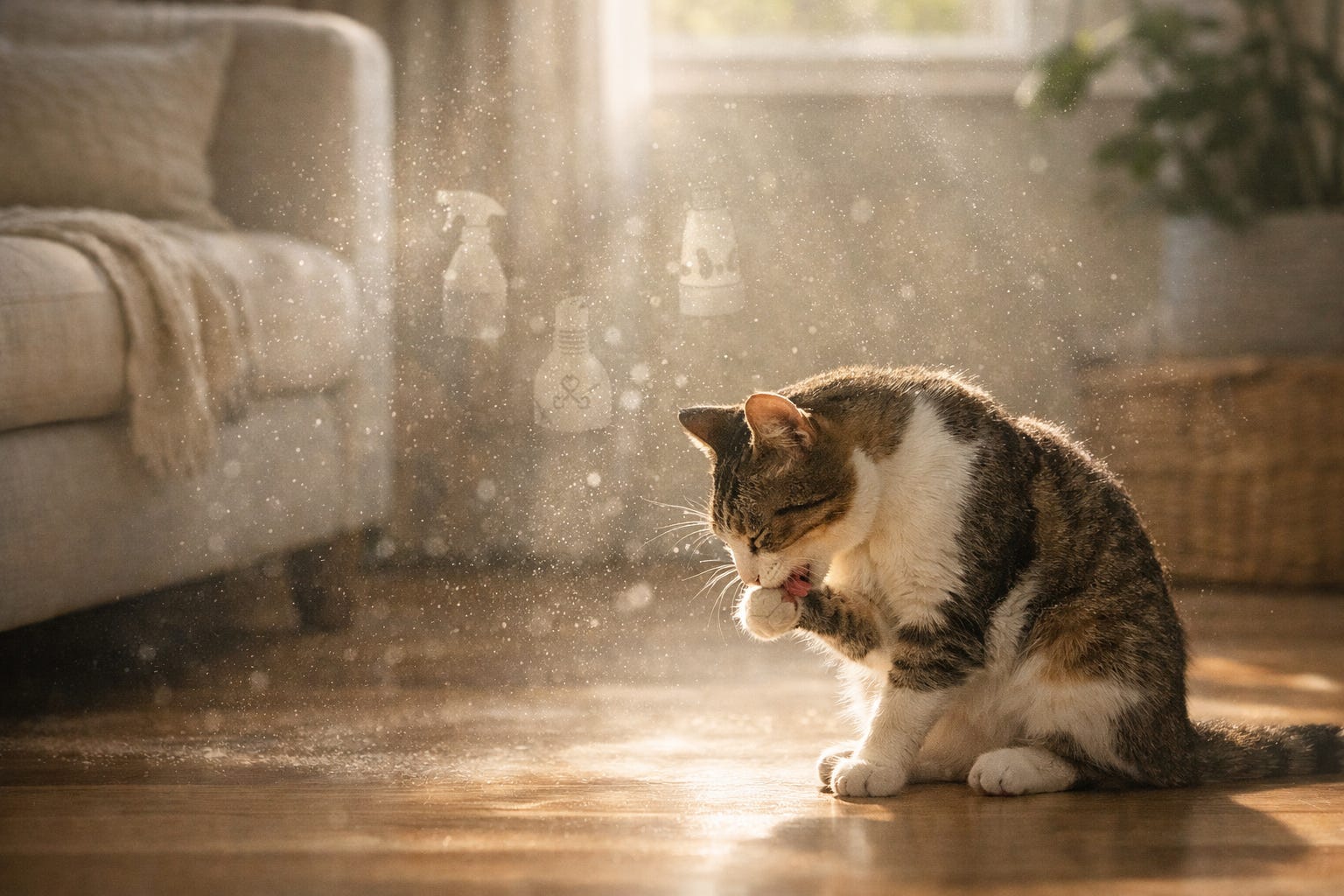
Cats groom themselves constantly, licking off whatever has settled in their fur and on their paws. The dust on your floor. The residue on your couch. The air freshener you sprayed this morning. It all goes somewhere.
Dogs exposed to lawns treated with a common herbicide were found to be twice as likely to develop lymphoma. Pesticide exposure in cats and dogs has been linked to mammary cancer, bladder cancer, and oral squamous cell carcinoma across multiple peer-reviewed studies.
The ASPCA’s Animal Poison Control Center received over 451,000 calls in 2024 related to toxic exposures in animals. Four hundred and fifty-one thousand calls. In one year.
We think toxins live somewhere else. They live all around us. And under our sinks.
The Nose Knows — And It’s Getting Sick
Nasal cancer in dogs used to be rare. It is becoming more common, and the research points in a consistent direction.
Veterinary oncologists have documented a clear connection between chemical exposure and nasal tumors in dogs. Flea sprays have been correlated with nasal tumor development. Air fresheners are explicitly named as a risk factor. The mechanism isn’t mysterious: dogs breathe at floor level, where airborne chemicals concentrate. Their noses filter everything. Over time, chronic exposure to VOCs, synthetic fragrance, and chemical residue creates the conditions for malignancy.
A study of 25 top-selling air fresheners and laundry detergents found 133 different volatile organic compounds, averaging 17 VOCs per product. Of those, 24 were classified as toxic or hazardous under U.S. law. Formaldehyde, a known carcinogen linked to cancers of the nose and throat, is found in common household cleaners, new furniture, synthetic fabrics, and scented products.
Your dog’s nose is filtering your home’s air. Every plug-in, every spray, every paraffin candle is going somewhere. It’s going through them. And your pet bed, the one that feels soft and looks cozy, was almost certainly sprayed with fire retardant chemicals before it ever reached your home. Fire retardants accumulate in household dust. Your pet sleeps on that bed, breathes that dust, grooms it off their coat. Night after night.
The Store That Smells Like a Warning Label
Walk into a Bath & Body Works. The scent hits you before you’re through the door. People love it. I hear about it constantly: “I just picked up their room spray,” “I got the plug-in refills on sale.” I understand the appeal. It smells like something good is happening.
It isn’t.
What you’re breathing in that store, and bringing home and releasing into the air your pets breathe twenty-four hours a day, is synthetic fragrance. “Fragrance” is a legally protected trade secret in the United States. Companies are not required to disclose what’s in it. A single “fragrance” ingredient can contain dozens of chemicals, including phthalates linked to hormone disruption and VOCs linked to respiratory damage.
Bath & Body Works is not uniquely evil. Victoria’s Secret. Fabuloso. Febreze. Pine-Sol. Tide. These are household names that people trust because they’ve always been there. The conglomerates behind them are not concerned about your chemical exposure. They are concerned about market share. And as long as people keep buying, the formulas will not change.
Here’s the number that should end the argument: the European Union has banned over 1,300 chemicals from cosmetics and personal care products. The United States has banned 11. The EU operates on the precautionary principle. If there’s evidence of harm, the ingredient is out until proven safe. The U.S. operates in reverse. A chemical stays in until harm is proven, a process that takes decades and requires fighting a lobbying apparatus that spends hundreds of millions of dollars making sure it doesn’t happen.
Eleven. Against thirteen hundred.
The products are the same. The chemicals are the same. The difference is that in Europe, they’re not allowed to sell them to you.
“My Pet Seems Fine.”
This is the part where I lose people. And I understand why.
Your dog is energetic. Your cat is eating well. Nobody is at the vet every month. Everything looks normal. So why would you change anything?
Here’s the problem with that logic: cancer doesn’t announce itself at stage one. Kidney disease doesn’t wave a flag before it takes thirty percent of organ function. Thyroid dysfunction, liver stress, chronic inflammation all build silently, over months and years, inside a body that looks perfectly healthy from the outside.
By the time your pet is showing symptoms serious enough to alarm you, the disease is often already established. You’re no longer in prevention mode. You’re in rescue mode, trying to slow something down that had a years-long head start.
Integrative pet health coaching isn’t for sick animals. It’s for the animals who look fine right now, whose owners want to understand what’s actually happening beneath the surface and get ahead of it before it becomes a crisis.
When I work with a client, we look at bloodwork. We look at diet. We look at the home environment: what they’re cleaning with, what’s on the lawn, what’s in the air, what flea and tick products are being used and how often. We build a picture of the full toxic load that animal is carrying. Then we build a plan to reduce it.
That’s what I did with Houston. That’s what I do with every client.
The best time to start is before your pet needs it.
Your Home Detox Checklist
I’ve learned this the long way, across a lot of years and a lot of different environments. The good news: you don’t need much. A few simple things replace most of what lines the shelves. Start with three this week and build from there.
Air
Remove all synthetic air fresheners: plug-ins, aerosol sprays, Febreze, paraffin candles, synthetic reed diffusers
Swap to natural beeswax candles, which burn clean without releasing toxic byproducts
Diffuse lavender essential oil for fragrance, one of the safest options for homes with pets
Open windows daily; even 15 minutes a day significantly reduces the toxic load building up in your home. Indoor air is measurably more polluted than outdoor air.
Add a HEPA air purifier in rooms where pets sleep
Let new furniture, rugs, and curtains off-gas outside before bringing them in; formaldehyde in pressed wood and synthetic fabrics is a documented carcinogen
Bedding
Your pet’s bed was almost certainly treated with fire retardant chemicals. Swap to certified organic pet bedding made with natural fibers
The same applies to your own bedding; natural fibers where possible, and wash new bedding before use
Avoid foam beds with synthetic covers; opt for wool, cotton, or hemp
Cleaning
Replace ammonia and bleach-based cleaners with Dr. Bronner’s peppermint castile soap; it works on floors, surfaces, and as a yard spray
White vinegar diluted in water cleans most surfaces without leaving chemical residue
Vinegar is also your fabric softener; pour it where you’d normally pour Downy
Skip the Swiffer and disinfecting wipes; the chemicals linger on surfaces pets walk on and lick off their paws
Read every label. If you can’t pronounce most of what’s in it, it doesn’t belong on a floor a pet walks on
Laundry
Switch to fragrance-free, plant-based detergent
White vinegar replaces fabric softener completely; no synthetic fragrance, no chemical softeners on the fabric your pet sleeps against every night
Eliminate dryer sheets entirely. Swap to wool dryer balls, or saturate a washcloth with white vinegar and toss it in the dryer as a natural fabric softener. It works.
Yard and perimeter
Eliminate rodenticide entirely. Use mechanical traps or bucket traps, relocate don’t kill if possible. Max died from a neighbor’s rodenticide. Yours could too.
Replace synthetic pesticides with food-grade diatomaceous earth; wear a mask, use a mister, apply around the perimeter of your home
Use Dr. Bronner’s peppermint castile soap in a hose-end sprayer over your lawn to deter bad insects
Plant a living perimeter: mint, rosemary, lemongrass, clover; find what grows in your zone
Consider replacing grass with clover or mini clover; beneficial to pollinators and requires no pesticides to maintain
Rinse your pet’s paws after walks if neighbors use lawn chemicals
Pest control on your pet
Research every flea and tick product you use; many contain chemicals linked to neurological effects in pets
Wondercide cedarwood and rosemary formulas are what I use and personally recommend
Talk to your vet before changing any treatment protocol; integrative care works alongside conventional medicine, not against it
Water
Filter your pet’s drinking water. The PFAS “forever chemicals” Erin Brockovich has spent her career fighting are in municipal water supplies across this country, in measurable concentrations, in cities that look perfectly safe on paper.
For a budget-friendly gravity filter: the Purewell stainless steel system requires no electricity, no plumbing, and removes chlorine, heavy metals, and sediment
For broader contaminant reduction including bacteria, viruses, fluoride, and lead: the Alexapure Pro is the stronger investment
Stainless steel or ceramic bowls only; plastic leaches hormone-disrupting compounds into water, especially in heat
Food
Read the label on your pet’s food the same way you read yours
Rotate proteins; variety reduces nutritional gaps and overexposure to any single ingredient source
Minimize ultra-processed pet food with synthetic preservatives, artificial dyes, and flavoring
Fresh, whole food where you can; even partial improvements matter
Some links above are affiliate links. I only recommend products I personally use or have vetted.
What Actually Works
This isn’t about being perfect. It’s about being deliberate.
Every swap reduces the load. Every plant you put in the ground instead of a pesticide stake is a choice that compounds over time. Every bottle of Febreze you don’t buy is one less thing your cat is grooming off her fur at 2am.
One study found that certain household chemicals run up to six times higher in dogs than in their owners, in healthy dogs, in ordinary homes, with no known exposure event. Six times. Because they’re on the floor. Because they’re smaller. Because they live inside the invisible cloud of whatever we’ve chosen to keep things clean.
They are carrying our choices.
Max didn’t get the chance to make a different one.
We do.
That’s my birthday wish. Not for me, for them. For Houston, who is currently in the backyard laying in the cedar mulch, earthing, watching the critters in the yard. For Lyra, who had a seizure earlier today and is still fighting hard enough without needing to fight her environment too. For Bella, who already survived one life she didn’t deserve and is building a better one. And for every dog and cat and rabbit and bird living in a home where someone loves them deeply and has no idea what’s in the air freshener they bought at Target last Tuesday.
Start somewhere. Start today. One swap.
They can’t read the label. You can.
A Birthday Offer — Because This Is the Work
Max’s story, Houston’s journey, Lyra’s fight. This is why I built Integrative Pet Parent.
Integrative pet health coaching isn’t about replacing your vet. It’s about looking at the full picture: bloodwork, environment, diet, history, and building a real program for your specific animal. The kind of review that asks why instead of just treating what’s visible.
“I went looking for help after my 12-year-old dog, Handsome Guapo Hank, had a medical emergency where I truly thought it might be the end. His bloodwork came back ‘normal’ and X-rays showed no blockage — but his behavior told a completely different story, and I knew something wasn’t right. After stabilizing him, I was still at a loss. Before working with Jenn, I felt helpless and overwhelmed. This experience changed everything. Jenn shares her expertise in a clear, practical way and shows you a path you can actually integrate into daily life, especially when it comes to nutrition and overall wellness. Small, manageable changes grounded in science. I now feel confident and empowered as an advocate for Hank’s health, even alongside his vet.”
— Caroline, Handsome Guapo Hank’s mom
The full intake is $350. For my birthday week, I’m opening ten spots at $100.
Here’s what’s included: you submit your pet’s intake information and any recent lab work. I review everything. We meet. I build you a personalized program, the same process I used with Houston, the same approach I’ve taken with every client.
Your pet seems fine right now. That’s exactly when to do this.
After I receive your form, I’ll send you a payment link and we’ll get you scheduled.
This offer closes midnight Sunday, April 6th. Ten spots. When they’re gone, they’re gone.
The Voices Worth Following
These are the people who have been sounding this alarm the longest. They are not radicals. They are credentialed professionals who looked at the evidence and told the truth before it was comfortable to do so.
Dr. Karen Becker is widely considered the most well-known integrative veterinarian in the world. Her life’s work is connecting what we feed, what we expose, and what we lose. The story of Max came through her family. That tells you everything about how personally she takes this.
Dr. Marty Goldstein is a Cornell-trained veterinarian, founder of Smith Ridge Veterinary Center, and author of The Nature of Animal Healing and The Spirit of Animal Healing. Four decades of treating chronic and degenerative disease in animals through integrative medicine. His position has never wavered: what we put in and around our pets’ bodies is directly connected to what kills them.
Dr. Judy Morgan is an integrative veterinarian, acupuncturist, food therapist, and author of eight books on natural pet care. After 37 years in clinical practice, her entire focus is education. Her message is unambiguous: minimize chemicals. Start now.
Dr. Andrew Weil is a physician, author, and founder of the University of Arizona Center for Integrative Medicine. His work focuses on human health, but the through-line is the same: the chronic disease epidemic in America is inseparable from our chemical environment. What harms us harms the animals living inside that same environment.
Erin Brockovich is the consumer advocate who helped build one of the most significant environmental contamination cases in American history, with no legal training. She has spent three decades fighting PFAS and industrial chemical contamination in water supplies across the country. Her message has never changed: chemicals shouldn’t enter our bodies before anyone proves they’re safe. We have the system backwards.
The Environmental Working Group produced the landmark Polluted Pets study. Nonpartisan, rigorously sourced, and worth bookmarking: ewg.org.
This is what Integrative Pet Parent is built for, cutting through the noise so you can make better choices for the animals who trust you completely. All content there is always free. Follow along.
Prefer to read in the app without the inbox noise? You can switch to app-only notifications in your Substack account settings under Notifications. I want this to work for you however works best.
Sources
Environmental Working Group, Polluted Pets study: ewg.org
ASPCA Animal Poison Control Center, Top Toxins of 2024: aspca.org
PlusChem / FDA: EU bans 1,300+ cosmetic chemicals; U.S. bans 11
University of Illinois / Journal of the National Cancer Institute: dogs twice as likely to develop lymphoma with 2,4-D herbicide exposure
Environmental Impact Assessment Review: 133 VOCs found across 25 top-selling air fresheners and laundry detergents; 24 classified toxic or hazardous under U.S. law
PetMD / Vetster: flea sprays and air fresheners correlated with nasal tumor development in dogs
NIH / peer-reviewed: pesticide exposure in dogs and cats linked to mammary cancer, lymphoma, bladder cancer, and oral squamous cell carcinoma


Happy Birthday Day! Wishing You Your Birthday Wish - one pet at a time!!! I would also encourage pet owners to consider making a shift to their pet’s wellness before there is an emergency.
If I look back, Hank is my second dog that had gut issues and my sweet Jaxy didn’t recover from his emergency and he was only 6 years old when I lost him. At the time, when I recognized his lethargy, I was told….” His bloodwork is normal”, ”he was fine”, “ don’t worry”, and he wasn’t.
What I do know is our environment is slowly giving us and our animals diseases that don’t show up until it is a major intervention (emergency)is required. And I know we can make little changes in our lives that will help us all and we can trust our gut (pun intended) to know when something is wrong with our fury friends and be our pets advocate.
Jenn keep talking about it, educating and helping your clients and know you have a new advocate for what you do and an advocate for my loves (pets)! Hank is recovering and on his way to his happy happy energy. And wow does Hank love his new food! Thank you!!!!