
Owned
What a shattered tv on a Saturday morning taught me about ownership, distraction, and building a life that holds.
My brother and I were watching Tom and Jerry when we should have been doing chores.
If you’re Gen X, you know exactly what that Saturday morning looked like. Carpet. Cereal. Possibly a sofa fort. The kind of cartoons that required nothing from you except to show up.
Mom and dad were out shooting a wedding. Professional photographers. Saturdays were their busiest days, and the deal was always the same: finish the list first. Dusting, vacuuming, dishes, bedrooms. All of it. Then we could enjoy limited tv time, including cartoons.
We thought we’d timed it right. One eye on Tom and Jerry, one ear on the driveway.
We miscalculated.
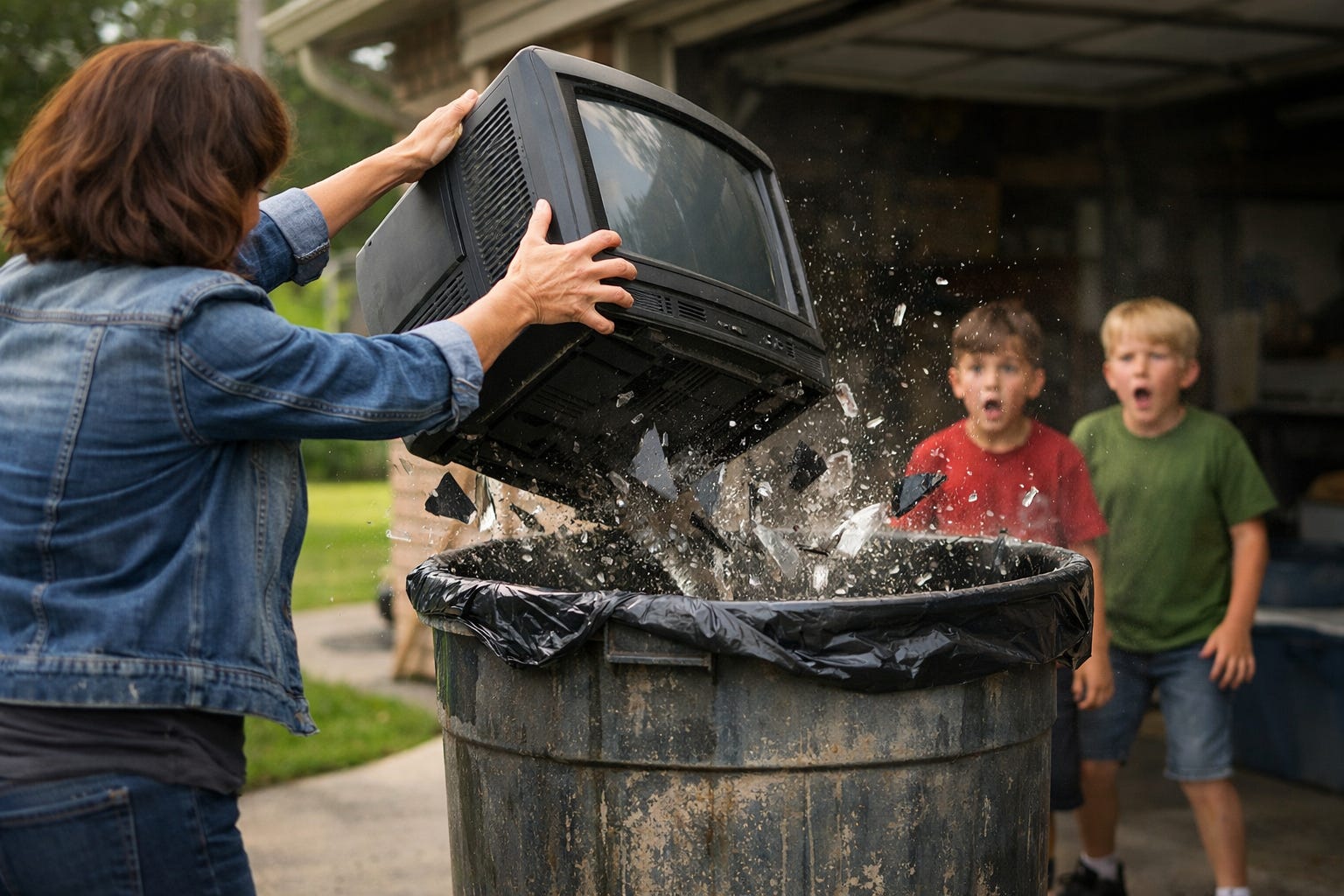
Mom came home early. Much earlier than normal. She walked into the family room, looked at us on the carpet, looked around at the chores not done, not even started, looked at the tv, and didn’t say a word. She walked over, picked up the large box tv, yanking the plug out of the wall, carried it outside to the garage, and threw it into the trash.
It didn’t just drop in.
It crashed. It shattered. We heard it from the garage door where we were standing, frozen. To a kid watching Tom and Jerry get destroyed in a million pieces — that is borderline traumatic. That is the kind of moment that imprints.
There is a reason Gen X’ers are so tough.
We didn’t have a television for seven years.
If this is hitting home already — like, comment, and share before you scroll further.
It helps more people find this.
Seven years is a long time when you’re a kid. I want to be precise about that. It wasn’t a week. It wasn’t a month. Seven years.
And here’s what I couldn’t have told you then: it was one of the best things that ever happened to us.
Without the tv, you find out what you actually do. We read. We went outside. We got bored — genuinely, deeply bored — and learned that boredom isn’t a problem to solve. It’s a condition that produces things.
Here’s what it produced in our family: opinions. Loud ones. Everyone in my family talks. Everyone has a viewpoint. We debate, we discuss, we argue, and then we eat dinner and do it again. Friends who came over for the first time would pull me aside afterward and say, “Everyone in your family has something to say about everything.”
Yes. We do.
I think seven years without a tv is a meaningful part of why. When there’s no screen to default to, you learn to articulate what you think. You learn to hold a position, defend it, and sometimes change your mind. Those aren’t soft skills. They compound in ways that take decades to fully see.
I came across a clip this week from The Madison, a new Paramount+ series from Taylor Sheridan, starring Michelle Pfeiffer. In it, a grandmother looks at her grandchildren and says what a lot of people are finally saying out loud: “…what spoiled little bitches we raised…”
The comment section was overwhelmingly one thing: she’s not wrong.
187,000 likes on a reel about a grandmother sitting in the wreckage of her own choices.
Some parents get it early. Some figure it out too late. Some never figure it out at all. The kids pay the price either way.
The difference isn’t love. Every one of those parents loved their kids. The difference is understanding early what a lot of people only see in hindsight. Discomfort is not the enemy. Ease is. Protecting your kids from every consequence doesn’t build them. It hollows them out. And one day you look up and wonder where you went wrong.
My mom picked up the tv on a Saturday morning in our family room and made sure that was never her story. None of us forgot it. I don’t think she did either.
I spent several years living largely out of hotels. Moving between projects, no fixed home base. When I finally had an apartment again and got my things out of storage, what I hadn’t sold in the meantime, there was no tv.
I could have gotten one. I didn’t.
Friends would come over and notice immediately. The wall where it was supposed to be. And then we’d just... talk. For hours. Real conversations. Not two people watching the same screen and commenting on it.
It turns out when you remove what people default to, you find out who they actually are. Yourself included.
When friends teased me about it, I had one answer: Whose convenience is this for?
I went ten years without a television. During a meaningful stretch of that time, I built a seven-figure business from scratch.
I’m not drawing a straight line between those two facts. But I’m not pretending the line doesn’t exist, either.
Building requires a certain kind of focused discomfort. You have to be able to sit with the problem long enough to solve it. Every time you reach for distraction before you’ve earned it, you’re borrowing against concentration you don’t get back.
The tv that shattered in our trash can on a Saturday morning taught me that before I had words for it. My mom wasn’t making a statement about television. She was making a statement about what we were there to do.
I’ve been thinking about this since reading a piece by Isabelle over at Wealthy Women Guide. She puts into words what doesn’t get said plainly enough:
There are people who pay monthly. And there are people who get paid monthly. The difference between those two groups isn’t income. It’s what they’ve decided to own.
Look at your monthly expenses. Not to judge them. Just to see them clearly.
Amazon Prime. Apple TV. YouTube TV. Netflix. Then the add-ons — HBO, Paramount, Disney, whatever came bundled with something else six months ago. That’s before we’ve touched the food delivery subscriptions. Add it up. Most people haven’t. Most people would be surprised if they did.
Now ask the question Isabelle is asking: what do you actually own?
Not access. Ownership.
Access feels like enough until it doesn’t. Until the platform changes the terms. Until the price goes up. Until the algorithm decides you’re not worth showing anymore. Access is rented. Ownership holds.
I go through this with people in our 22 Days to Financial Freedom course. The subscriptions are always there. Line items people set up and forgot. And the pattern underneath them is almost always the same: spending on things that fill time instead of build it.
There’s a version of minimalism that’s about aesthetics. White walls, fewer clothes, capsule wardrobes. That’s not what I’m talking about.
I’m talking about a question you ask before every recurring expense, before every hour, before every habit:
Is this building my life, or just filling it?
When I moved to Florida, I finally bought a tv. I was in and out of the hospital more than I’d like to say, and sometimes you just need to lie on the sofa and watch something that asks nothing from you.
I gave myself that. No apology for it.
But here’s what ten years without one taught me: I knew exactly what I was buying it for. Not habit. Not background noise. Not because everyone else had one. I bought it because I had earned the right to choose it, and I knew the difference between choosing and defaulting.
That distinction matters more than people realize. Going without for a stretch of time doesn’t just save money or produce focus. It recalibrates your relationship with the thing itself. You stop consuming by default. You start consuming by decision. Those are not the same life.
Even now, tv on during the day is a sore spot. My parents know it. When I’m traveling for advance work or speaking, I can go an entire hotel stay without turning it on once. That used to feel like discipline. Now it just feels like what I do.
The Saturday morning when my mom threw that television into the trash — when my brother and I heard it shatter from the doorway — I thought it was the worst thing that had ever happened to me.
I was wrong about that. I was wrong about a lot of things that turned out to be the making of me.
She wasn’t punishing us. She was building us. There’s a difference, and most people don’t understand it until they’re standing on the other side of something hard, looking back.
Whose convenience is it for?
I’m still asking. Forty years later, it’s still the right question.
If this resonated, share it with someone who needs to hear it. And if you’re not already subscribed, join us at The Jenn Files — business, money, resilience, and grit, cutting through the noise so you can build something that can’t be broken.
Prefer to read in the app without the inbox noise? You can switch to app-only notifications in your Substack account settings under Notifications. I want this to work for you however works best.


