
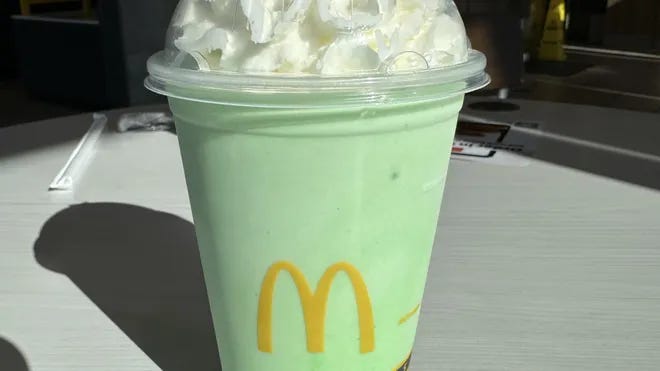
Shamrock
The best leadership training I ever got came with a name tag and a visor.
I got a Shamrock Shake yesterday.
Bella and I had just come from the dog park. I drove through the drive-thru, ordered a shamrock shake and a pup cup for her, because she earned it of course, and we drove over by the ocean and sat in the parking lot together watching the waves. Me drinking something that is almost certainly more chemicals than dairy. Her licking whipped cream off her nose. RFK Jr. would have a field day with both of us. I didn’t care. It’s March. It’s green. It’s tradition. And some things you just have to enjoy every so often.
But sitting there — green shake in hand, Bella in the passenger seat demolishing her cup — I wasn’t thinking about mint syrup.
I was thinking about 24 burgers on a grill.
Let me explain.
My first real job outside the family business was McDonald’s. I was around fourteen or fifteen, and if you’re Gen X, you understand. We couldn’t wait to get our license, our own wheels, and the freedom of what we perceived was independence. We wanted to work. We wanted our own money. We wanted out of the house and into the world.
I had a plan. I was going to save enough money to prove to my parents that I was responsible enough to be selected as an exchange student and go live in Venezuela. So I worked. I saved. I proved it. And I went.
When I came back the following year, I went right back to McDonald’s.
Compare that to today. Gen Z waits to get licenses. Relies on rideshare apps and parents. Lives at home longer. I’m not judging, I’m observing. Because that hunger to get out and build something, even at fourteen, even if it was just a paycheck from a fast-food restaurant to fund a dream that felt impossibly big? That shaped everything that came after.
McDonald’s was where it started for me. And what I found there, both times, was nothing like what most people picture when they think of a kid working at a fast food restaurant.
A 24-turn.
That’s twenty-four burgers laid on the grill at once. You drop them, you season them, and when it’s time to flip — you’re already laying down another twenty-four on the open space. So now you’ve got forty-eight burgers on the grill in various stages of cook, and you don’t miss a single one.
This was not in the official McDonald’s training manual. Corporate would not have stamped this with approval. But in a well-run store with the right people on the grill? A 24-turn was the difference between keeping up with a Friday lunch rush and drowning in it. Only a few people I’ve ever seen could execute a turn at that level — the speed, the precision, the ability to track dozens of burgers at different stages without losing a beat.
While those burgers are turning, someone else is toasting buns. Someone else is lining them up — ketchup, mustard, onion, pickle. Cheese if it’s a cheeseburger. Double? Stack it. Triple? Don’t even think about hesitating. Every hand has a job. Every second is accounted for. And if you’re running the grill during a lunch rush on a Friday, you better not be the one who breaks the rhythm.
That’s not fast food. That’s a system. That’s precision under pressure. That’s a team operating like a machine — except the machine is powered primarily by teenagers and twenty-somethings who somehow learned to execute at a level that most corporate teams never reach.
“If you’ve got time to lean, you’ve got time to clean.”
Every person who’s ever worked at McDonald’s just nodded. That wasn’t a suggestion. That was the standard. There was no dead air. No standing around. No “that’s not my job.” You were either serving, prepping, cleaning, or helping someone who was. And the phrases, the internal language, the shorthand, it was like a secret code. You either knew it or you didn’t. And if you didn’t, you learned fast, because you didn’t want to be the one holding up the team.
Our standard was getting people through the drive-thru in under sixty seconds. Sixty. The longest part of the experience was supposed to be the customer placing their order at the speaker. By the time they pulled to the window, their food should be ready, bagged, and handed over with a smile.
Today? The average McDonald’s drive-thru experience is eight to ten minutes. Some stores are so bad they’re now advertising that they’ll get you through in under five minutes or your money back. Five minutes. As a selling point. We would have been embarrassed.
The training programs in that era were genuinely world-class. McDonald’s created Hamburger University in 1961 in the basement of a restaurant in Elk Grove Village, Illinois — one of the first corporate education programs ever built. Over 275,000 people have graduated with a degree in Hamburgerology — or HU, as it’s known inside the company. Today, more than 5,000 students attend annually, and 40% of McDonald’s global leadership has gone through the program. The acceptance rate at the Shanghai campus? Under one percent. More selective than Harvard. Think about that, as common as McDonald’s is, their training program is more prestigious and harder to get into than the Ivy League. Go figure.
But you didn’t have to go to Hamburger University to feel the culture in a well-run store. You felt it from your first shift. You felt it in the speed. The language. The expectation that you would rise to the standard or get out of the way.
I was supposedly the youngest certified manager in the McDonald’s hierarchy at the time. I’m sure some young hotshot has taken that over by now. But I’m proud of it, not because of the title, but because of the people who made it possible.
Michael (Mickey). Greg. Matt.
These three managers ran the store on Merle Hay Road in Iowa, and I have measured most everything I’ve done in my career — every business I’ve built, every team I’ve led, every operation I’ve run — against the standards they set.
They could run a 24-turn like no one I’ve ever seen. Reading the flow, anticipating orders, calling out what was coming before it hit the screen. It wasn’t just cooking. It was orchestration. They knew the rush before it arrived. They positioned people where they’d be needed three minutes from now, not where they were needed three minutes ago.
And they did it while building a crew that was unlike anything you’d find in a corporate org chart.
Think about who worked in that restaurant.
High schoolers on their first jobs. Full-time adults making their wage and supporting families. Senior citizens on social security who could only work a certain number of hours before it affected their benefits. And a group of people from a local group home for those with disabilities, who most often helped in the dining area.
That’s not a staff. That’s a community. Every age. Every walk of life. Every ability level. All under one roof, all held to the same standard, all part of the same team.
Kathy was our senior citizen. She was most often running the drive-thru window, and she ran it like a drill sergeant. You better have the napkin placed just so. The top of the bag folded over just right. The order correct, the smile genuine, the handoff clean. Kathy didn’t care how old you were or how long you’d been there — if your bag fold was sloppy, you were going to hear about it.
The standards.
That’s what made it work. Not because everyone was the same — they couldn’t have been more different. It worked because Mickey, Greg, and Matt created an environment where every single person understood that their role mattered. The high schooler on the grill. The adult running the line. The person from the group home keeping the dining room spotless. Kathy at the window, making sure every bag that left that building represented something worth being proud of.
You cannot get that experience on Zoom. You cannot replicate it in a Slack channel. You can only build it by putting people in a room together, giving them a shared standard, and letting them rise to it.
Tom. Patty. Diane. Jennifer. Mark. Alexis. Trevor. Shelly. And so many others. They changed my life. I was young, naive, and hanging with the grown-ups. I see now just how young and naive I really was. And they watched out for me. Every single one of them.
I’m still connected to many of them on social media. I get glimpses into their worlds — where they are, what they’ve built. It matters more than they probably know.
We even went on a ski trip together once. To Steamboat Springs, Colorado. A road trip. From Iowa.
You know you have something special when an entire crew of McDonald’s managers and a Regional Supervisor coordinates a trip to the mountains. That’s not a workplace. That’s a family.
I was doing some mogul skiing through the trees with the group, feeling invincible, obviously — and missed a final jump. My ski binding had been set too tight, so when I went down, the ski didn’t release. It stayed locked on. I became a helicopter — spinning, wrapping around, flailing about, and my hand and thumb folded back until they snapped.
Emergency room. Steamboat Springs. On a McDonald’s ski trip.
I’m fairly certain Mickey does not reminisce about this moment with great fondness. But I do. Because I see a group of people who showed up for each other — not just behind the counter, but in real life. On a mountain. In an ER. That’s what a team looks like when someone actually builds one.
I was so stubborn, I refused to be sledded down in the recovery sled. So they wrapped my arm and hand with chicken wire and bandages, Lori carried my poles, and we skied down slow — because I was not getting in that sled. I remember Mickey in the ER, telling the doctor how stubborn I am.
Some things never change.
Years later, I built a pet services company from zero to seven plus figures. And when it came time to build a team of my own with a diverse group of people from various walks of life, I carried Merle Hay Road with me.
The culture I built at DCDS was rooted in what Mickey, Greg, and Matt taught me — that the people matter as much as the product. That standards aren’t optional. That you build a team people don’t want to leave. The tighter the systems, the stronger the team.
I got some things really right. And some things — I look back now and just say ouch. I wish I’d done that better.
I had to let a manager go once. And his words to me were: “I feel like I’m losing my family.”
That sentence has stayed with me. Because it told me two things at once. First — the culture was real. He didn’t say he was losing a job. He said he was losing a family. That means something was built there that mattered. Second — I could have handled parts of it better. The decision may have been right, but the way I navigated it? There are things I would do differently if I could go back.
That’s the weight of building something people care about. When the culture is real, every decision carries more. Getting it right matters more. And getting it wrong costs more — not just operationally, but humanly.
I anchor those lessons back to the trio on Merle Hay Road in Des Moines, Iowa. They showed me what it looked like to hold a standard and hold people at the same time. I’m still learning how to do both.
Now here’s where it gets real.
I have genuinely thought about going down to my local McDonald’s and getting a job. Not for the paycheck. Because something has broken, and I want to understand how far down it goes.
We have lost the art of the most basic human interactions. Please. Thank you. Hello. Goodbye. Welcome in. Thank you for coming. We appreciate you choosing us today. These are not complicated phrases. They’re the bare minimum of human connection in a service interaction — and they’ve vanished from most of them.
The drive-thru tells the whole story. We held ourselves to sixty seconds. Today, stores are running eight to ten minutes and bragging about getting it under five. The crew doesn’t communicate. The grill isn’t timed. Food is staged and nuked, not even done fresh on a grill any longer. Nobody smiles at the window. And the bag? Kathy would lose her mind.
But here’s what people miss: the speed was never the point. The speed was a byproduct. It came from something underneath — teams that communicated, managers who built systems, and a culture where every person on the floor understood they were part of something that worked. When the culture is right, the speed takes care of itself. When the culture is gone, no amount of technology or AI menu boards will fix what’s broken.
This isn’t just about McDonald’s. This is about every business owner and leader reading this right now.
How are you showing up for your team? Not your Slack channel. Not your Monday standup on Zoom. Your team. The actual human beings who do the work alongside you — are you building something they want to be part of? Are you creating a culture where people watch out for each other because the environment makes it natural? Or are you managing tasks and wondering why nobody seems to care?
The best teams I’ve ever been part of — in presidential advance, in business, in a McDonald’s on Merle Hay Road — all had the same thing. Someone decided the people mattered as much as the product. And they built a culture to prove it. Not with motivational posters. Not with pizza parties. With standards. With language. With showing up every single day and demonstrating what excellence looks like until it became the air everyone breathed.
Mickey, Greg, and Matt did that in a fast-food restaurant in Iowa. With high schoolers, working parents, senior citizens, and people from a group home — running a 24-turn on the grill while making sure every single person on the floor knew they were part of something worth being proud of.
What’s your excuse?
My hope is that McDonald’s finds its way back. Start with the basics. Real ingredients — use actual beef tallow for the fries instead of seed oils. Real training that builds people, not just fills shifts. And real human connection — the kind that makes a fifteen-year-old kid from Iowa feel like she’s part of something worth fighting for.
But don’t wait for McDonald’s. That’s your job. In your business. With your team. Starting today.
Have you ever worked at McDonald’s? I want to hear your stories. Drop them in the comments — because I guarantee there’s a Mickey, a Greg, a Matt, or a Kathy in your story too. And they deserve to be remembered and celebrated.
The Jenn Files is where presidential-level advance and a seven-figure business exit meet real life. I write about business, money, resilience, and grit — cutting through the noise so you can build something that can’t be broken.


