
THE GAP. Part II. Follow The Money
The system isn’t broken. It’s bought. And the receipts are public record.

If you read Part I, you know the numbers.
The premiums that consume 94% of a $63,000 income. The friend rationing transplant medication. The MRI I’ve been waiting three months for. The gap between what Congress pays and what the rest of us pay.
Now, let’s follow the money that built those numbers.
Before anything else, I want to say this clearly:
I am not opposed to Medicaid reform. The abuse is real. I have seen it with my own eyes. Work requirements are not an unreasonable ask. Accountability is not cruel.
What I’m opposed to is a system that punishes the people who built something, paid their taxes, played by the rules, and still can’t afford to get sick. Americans who did everything right — bearing the full weight of a broken structure while the people responsible for fixing it are spending their days on the phone raising money for their next campaign.
Small businesses employ nearly half of the American workforce. They don’t have HR departments negotiating group rates. They don’t have taxpayer-subsidized Platinum plans. They have a browser window, a healthcare.gov login, and a number that doesn’t work.
The math does not math.
That’s the story. Let’s tell it.
The Abuse Is Real. I’ve Seen It.
I’m going to tell you three stories. No names. These are real first hand accounts.
I had a friend in DC, originally from Africa. She came over on a student visa, did one semester of school, then overstayed. Used an asylum claim to eventually get citizenship. When her father got sick, he came to the United States with no health insurance and simply went to the emergency room every time he needed care. That’s how it works. The ER cannot turn you away. He qualified for emergency Medicaid, which opened the door to broader benefits.
I watched it happen.
In Florida, I had a service provider, originally from France. From outward appearances, a thriving small business. Routinely booked, her own salon space, seemingly doing well. Two kids. She knew exactly how to keep her reported income low enough to qualify for Medicaid and subsidized private school for her children. I know because I overheard her on the phone one day making exactly that claim: that she had very little income and couldn’t work much. She also flies back to France twice a year to visit family. She hung up and looked right at me, as though we were in on it together, and said she had to make sure certain things were reported a specific way to keep her subsidies in place.
That was my last appointment.
I’m not telling these stories to vilify immigrants. My own mother is a post-war immigrant from Sweden who came to this country legally with nothing and built a life. The issue is not where someone is from. The issue is a system with enough gaps in it that people, from multiple countries, on multiple visa types, at multiple income levels, can find their way through those gaps while the people who actually need the program get caught in the crossfire.
The third story is closer to home.
She worked for me briefly at my pet services company. Critical thinking wasn’t her strong suit, and she wasn’t there because she wanted to grow. She needed a job. Single mom. Young. No baby daddy around. A baby depending on her.
She knew the game though. She didn’t need anyone to explain the system to her. She’d grown up inside it. Her mother had run the same playbook. Now it was her turn.
She showed up late. Response time was a problem. She had a baby and we were going to fight for her anyway.
Then one day she just didn’t show. No call. No warning. Nothing.
When she resurfaced late that afternoon, I asked where she’d been. She told me she had a bad tooth infection and had gone to the ER.
Why the ER?
She explained it like it was obvious: if she went to a dentist, she’d have to pay money. If she went to the ER, they’d treat her for free and give her pain medication.
She wasn’t wrong. That’s exactly how it works.
I wanted to scream, not at her, but at what built her. She didn’t invent that workaround. She inherited it. And somewhere down the line, her child would too.
That’s what a system looks like when it has failed long enough to become normal.
The fraud isn’t anecdotal. Former Palm Beach County State Attorney Dave Aronberg documented it in his book Fighting the Florida Shuffle: The Inside Story of Corruption in the Drug Treatment Industry and How One Community Found the Solution. How profit-driven operators lure vulnerable people into substandard rehab facilities, billing insurance until the patient leaves in an ambulance or a body bag. Patient brokering. Illegal kickbacks. Well-intentioned policies twisted into incentives for relapse over recovery. Aronberg’s task force made over 120 arrests and helped cut opioid deaths in Palm Beach County by 17%. The fraud was real. It was documented. It was prosecuted. And it still took years to claw back.
That’s what accountability looks like when someone actually does the work.
The fraud exists at every level. From a dollar here and there all the way up to billions. From individuals gaming eligibility to corporations overbilling Medicare by hundreds of millions.
And here is the question I keep coming back to:
How in the world can we continue to take care of the rest of the world and everyone who comes here if we can’t even take care of our own people first?
That is not a radical question. It is the obvious one.
The Job They’re Actually Doing
Members of Congress earn $174,000 a year. Taxpayer funded. To represent you.
Serve one term. Serve part of one term. Serve thirty years. It doesn’t matter. When they leave, they are paid for the rest of their life. A pension funded by the same taxpayers they stopped representing the moment they walked out the door.
Here is how they actually spend their time.
New members of Congress are handed a model daily schedule. Of a 9 to 10 hour workday, only 2 hours are allocated to legislative work. The actual job. The rest is fundraising. Call time. Donor outreach. Reelection.
The political parties expect members to spend 30 hours per week in party call centers located across the street from the Capitol. Buildings that exist specifically for this purpose, because it is illegal to fundraise from a congressional office.
They built separate buildings. Because the fundraising is so constant, so expected, and so central to the job that it needed its own real estate.
“Members of Congress spend too much time raising money and not enough time doing their job.” — Former Florida Congressman David Jolly
“Fundraising quotas are discouraging good people from running for office.” — Former Minnesota Congressman Rick Nolan
These are not outside critics. These are people who lived inside it.
In the 118th Congress, House members who ran for reelection in 2024 collectively raised $1.2 billion between January 2023 and December 2024. A House member in a competitive race raised a median of $7.9 million, roughly $10,900 per day.
Every hour spent raising that money is an hour not spent on healthcare policy. Not spent on the cost of insurance. Not spent on the small businesses carrying the full weight of a system nobody in Washington has been incentivized to fix.
An intelligence analyst I follow posted this before taking it down. I saved it because it said what a lot of people are feeling but won’t say out loud.
“I voted for no wars, mass deportations of the millions of illegals allowed to cross during the Biden administration, a better economy, and draining the swamp. The list was short. Yet every single person I had faith in has been blatantly bought or blackmailed. Fck you all. I’m not sitting idly by while you ruin our country and gaslight us. We aren’t dumb like you apparently think we are. Get ready.”
She took it down. That tells you something too.
That is not a fringe position. That is millions of Americans right now.
And the data explains exactly why she feels that way.
Who’s Paying Them
In the 2023–2024 election cycle, pharmaceutical and health product companies gave $26.4 million to Democrats and $16.1 million to Republicans. Democrats received noticeably more. At least 72 of the 100 sitting U.S. senators received at least $10,000 from the industry. Twelve received over $100,000. Seven were Democrats. Five were Republicans.
Both parties. Every time.
Top Senate recipients — Democrats, 2024:
Bob Casey (D-PA): $520,776
Jon Tester (D-MT): $401,885
Sherrod Brown (D-OH): $372,314
Jacky Rosen (D-NV): $266,422
Ruben Gallego (D-AZ): $244,135
Tim Kaine (D-VA): $200,824
Adam Schiff (D-CA): $196,635
Top Senate recipients — Republicans, 2024:
Marsha Blackburn (R-TN): $316,656
Bill Cassidy (R-LA): $290,375
John Barrasso (R-WY): $204,761
Thom Tillis (R-NC): $131,955
Ted Cruz (R-TX): $101,621
Source: OpenSecrets, FEC data released February 2025.
Now look at the House.
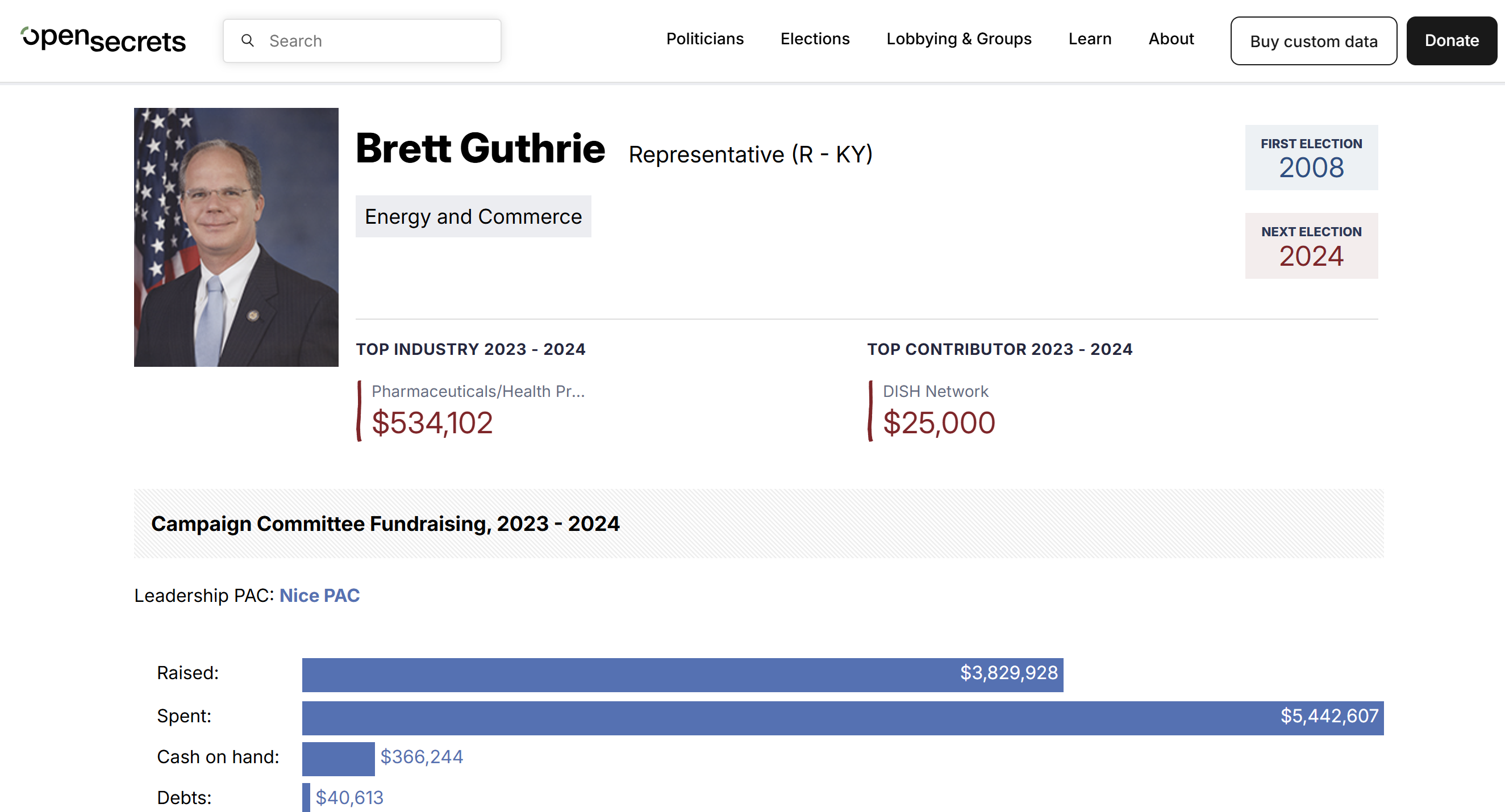
Rep. Brett Guthrie (R-KY) chairs the House Energy and Commerce Committee. It is the most powerful position in Congress for healthcare regulation. His committee has direct jurisdiction over Medicaid, Medicare, and prescription drug safety.
In 2024, he received $534,102 from pharmaceutical and health product industries. Over his career, he has collected over $1.8 million from those same industries, more than any other currently serving Republican in the House.
When he became committee chair in January 2025, his PAC fundraising more than tripled. Around 100 PACs that had never written him a check before became donors the moment he got the chairmanship.
The man overseeing healthcare regulation in Congress is the single biggest recipient of healthcare industry money in the House.
Read that once more.
You can verify it yourself: Brett Guthrie — 2024 Campaign Finance Summary
The Revolving Door
Of the 51 lobbyists working for America’s Health Insurance Plans in 2024, 31 had previously held government jobs.
Government employees one year. Industry lobbyists the next. Writing the rules, then getting paid to work around them.
This is legal. Every bit of it. That’s the part that should keep you up at night.
The insurance industry didn’t buy Congress with illegal bribes. It did something far more effective. It built relationships over decades. Funded campaigns. Placed former employees in regulatory positions. Hired former regulators as lobbyists. Created a permanent, professional, well-funded operation that never stops running, whether Congress is in session or not.
By the time a vote happens, the outcome has often already been shaped. Not in the chamber. Not on the floor. In a dinner. A donor call. A hire made two years earlier.
Read that again.
By the time a vote happens, the outcome has often already been shaped.
The vote is the last step. Not the first.
The Money Machine. Both Sides.
The separate buildings aren’t the real problem. They’re the symptom.
The real problem is what happens once money enters the system. Direct donations are only the beginning. From there it flows through PACs, Super PACs, 501(c)(4) dark money organizations, leadership PACs used as personal expense accounts, and nonprofit structures where affiliated entities share an office while money cycles between them with minimal disclosure required.
This is not a Republican problem or a Democratic problem. It is a system problem. And both parties have built the same infrastructure.
On the left: ActBlue processed $3.8 billion in the 2023–2024 election cycle. Its nonprofit arms paid out $407 million in a single year, reported as one line item. No breakdown. No list of recipients. Hundreds of millions of dollars moved through a tax-exempt structure with no public disclosure of where it ultimately landed.
On the right: WinRed is the direct mirror. Since 2019 it has processed over $2.8 billion for Republican candidates and committees. Same structure. Same lack of transparency. Same result.
Neither one is required to tell you where the money actually goes.
The rules were written by the people benefiting from them. That is why they haven’t changed.
The Vote
On July 4, 2025, Independence Day, President Trump signed the One Big Beautiful Bill Act into law.
The House passed it 218 to 214. The Senate passed it 51 to 50, with Vice President JD Vance casting the tiebreaking vote. Only two Republicans in the House voted against it. In the Senate, only Susan Collins of Maine, Thom Tillis of North Carolina, and Rand Paul of Kentucky crossed their party.
One vote. That was the margin.
Who Actually Loses
Total U.S. healthcare spending in 2024 was $5.3 trillion. Medicaid alone accounted for $931.7 billion of that. The federal government paid 64.7% of the Medicaid share. It makes up 30% of the average state budget, the single largest category of state spending after K-12 education.
The top five states by total Medicaid spending: California, New York, Texas, Pennsylvania, and Florida. The five most populous states in the country. This is not a small program serving a niche population. It is the backbone of healthcare coverage for one in five Americans.
The system costs too much. That is not in dispute.
Let me be clear about where I stand.
Americans are among the most generous people on earth. We give. We volunteer. We build nonprofits and community organizations and faith-based programs that serve people in need, all over the world and right here at home. That generosity is real and it matters.
But the federal government’s first obligation is to American citizens. The people who were born here, built here, paid into the system here, and need it to be there when life falls apart.
Nonprofits exist for a reason. Private charity exists for a reason. Those are the right vehicles for serving people who come here seeking a better life. The federal benefits system is not that vehicle. It was never designed to be.
What we have right now is a system so riddled with fraud and abuse that it is failing the very people it was built to protect. Pathways designed for emergency care used as planned delivery strategies to establish eligibility. Emergency rooms used as primary care because there is no cost to showing up. Businesses run in cash while the owner qualifies for subsidies. Asylum pathways used as benefit pipelines.
Legal immigrants should have a path. But that path runs through citizenship, not through the subsidy system on arrival. That is not cruelty. That is a boundary. Every functioning country has one.
The groups that should never be touched: children. Pregnant women who are citizens. Veterans. Americans who built something, paid into the system, and need it to be there when life goes sideways.
The abuse is real. I’ve seen it firsthand — and it isn’t limited to one tax bracket. People who know exactly how to report income, structure their lives, and work the system while collecting benefits they were never intended to receive. The French salon owner wasn’t an anomaly. She was just the one who said the quiet part out loud to my face.
People with disabilities and seniors over 65 represent 20% of Medicaid enrollees but account for 51% of program spending. If Congress was serious about reform, that’s where the conversation would start — fixing the structure that allows the abuse, and protecting the people the program was actually built for.
Instead they cut the working poor. The people least equipped to fight back and, not coincidentally, the least likely to write a check to a reelection campaign.
That’s not reform. That’s convenience dressed up as policy.
The system needs to be rebuilt. What it does not need is to be blown up without anything viable to replace it. Right now that is exactly what is happening. The explosion without the safety net.
This is not a secret. Everyone sees it. Nobody with the power to fix it does.
And when Congress finally acts, the veterans lose coverage. The disabled lose coverage. The American children lose coverage.
The fraud goes untouched. The citizens bear the cost.
When hundreds of millions of dollars flow from lobbyists into the campaigns of the people writing the rules, the voices that actually need to be heard get lost. The constituent who can’t afford her prescription. The veteran waiting months for care. The small business owner paying full freight for coverage that gets worse every year and can't afford to lose a single employee to a system that was never designed to include her.
They don’t have a PAC. They don’t have a lobbying firm. They have a vote, and they’re starting to figure out that even that has been managed.
That is not reform. That is the system working exactly as designed, for everyone except the people funding it.
The Math Nobody Runs
A lot of people ask a version of the same question. I’ve asked it myself.
Why couldn’t we just do a flat tax for healthcare? Everyone pays 3%. Simple. Fair. Done.
It’s a reasonable instinct. Here’s the honest math.
A 3% flat tax on all U.S. personal income, wages, investments, everything, raises approximately $720 billion. Medicaid alone cost $931 billion in 2024. Medicare costs roughly another trillion on top of that. Total national healthcare spending is $5.3 trillion.
Three percent doesn’t cover it. You’d need somewhere between 6 and 7 percent just to cover Medicaid and Medicare as they exist today. To cover everything, you’re looking at closer to 22 percent.
But here’s what nobody tells you: the reason the math looks that bad is because the system itself is broken. The United States spends two to three times what other developed countries spend per person and gets worse outcomes. The problem isn’t the tax rate. The problem is what we’re funding.
Fix the cost structure first. Eliminate the fraud. Remove the profit margin from the middlemen. Then run the math again. It looks different.
That is what Part III is about.
Before you scroll, hit the like button and comment.
This is how you can help me and help others find me.
What You Can Do Right Now
Look up your representative at opensecrets.org. Search their name. Look at the top industries funding their campaigns. Look at how they voted on the One Big Beautiful Bill. Put those two side by side. You don’t need a political science degree to read what you see.
Call them. Not email. Call. Congressional offices track call volume. It registers in a way emails don’t. Tell them you know what they were paid and what they voted for. Tell them you are paying attention.
Vote in every election. Not just the presidential ones. The people making healthcare decisions at the state level run in off-cycle elections with very low turnout. Low turnout means your vote counts more. Use it.
Talk about what you pay. Post your number. Share Part I. Share this one. Both.
Run the search. Go to stridehealth.com. Enter your real information. No subsidies. Screenshot what comes back. Then enter zip code 20001, Capitol Hill. Screenshot that too. Share both. That is the story in two images.
The system is not broken.
It is working exactly as designed. For the people funding the campaigns of the people writing the rules.
We want a system that works for legal citizens who built something, paid into it, and need it to be there when life goes sideways.
That is not too much to ask.
Part III is the rebuild. Three real options. Real tradeoffs. What would actually fix this and what it would cost.
That is next.
Not yet a subscriber?
Every week, The Jenn Files cuts through the noise on business, money, resilience, and grit written for people who are building something real. If The Jenn Files is part of how you make sense of the world, consider becoming a paid subscriber. Your support is what keeps this work going.
Sources:
Pharma/health gave $26.4M to Democrats, $16.1M to Republicans in 2024: Deseret News / OpenSecrets, January 2025
72 of 100 senators received pharma/health PAC money 2024, individual amounts: OpenSecrets, FEC data released February 2025
Brett Guthrie — $534,102 in 2024 (verified OpenSecrets screenshot), $1.8M career total, PAC fundraising tripled after chairmanship, 100 new PAC donors: OpenSecrets / Read Sludge / Kentucky Lantern, December 2024 – October 2025
America’s Health Insurance Plans — 31 of 51 lobbyists former government employees: OpenSecrets.org
Congressional model daily schedule, 2 hours legislation, rest fundraising: U.S. Term Limits, Issue One, Georgetown Government Affairs Institute
30 hours/week fundraising: Issue One Congressional Fundraising Treadmill, 2021–2024
$1.2 billion raised by House members 2023–2024, median $7.9M in competitive races: Issue One, 118th Congress Fundraising Treadmill, February 2025
ActBlue — $3.8 billion raised 2023–2024 cycle: OpenSecrets / FEC
ActBlue nonprofit arms — $407 million paid out in 2020 as single line item, no recipient disclosure: Capital Research Center
WinRed — $2.8 billion processed since 2019, FEC complaint filed by Campaign Legal Center: Campaign Legal Center, 2022
One Big Beautiful Bill Act signed July 4, 2025 — House 218-214, Senate 51-50: Brownstein Hyatt Farber Schreck, July 2025
Total Medicaid spending 2024 — $908.8 billion, 64.7% federal: Health Management Associates / CMS, October 2025
Medicaid 30% of state budgets, single largest spending category: Peter G. Peterson Foundation, July 2025
CBO — 10.9–11.8 million lose coverage, $1 trillion in cuts: Congressional Budget Office, 2025
4.8 million lose coverage due to work reporting requirements: Georgetown University Center for Children and Families, June 2025
Arkansas work requirements — 18,000 lost coverage due to paperwork failures: KFF / CBO
People with disabilities and elderly — 20% of enrollees, 51% of spending: MACPAC MACStats 2024 Data Book
GAO — 70% of Medicaid recipients work 35+ hours/week: U.S. Government Accountability Office
Dave Aronberg, Fighting the Florida Shuffle — 120+ arrests, 17% reduction in opioid deaths: Amazon / Florida Politics, June–July 2025
Congressional health benefits — 72–75% taxpayer subsidized: OPM, Congress.gov
Prefer to read in the app without the inbox noise? You can switch to app-only notifications in your Substack account settings under Notifications. I want this to work for you however works best.