
The Ice Cream Truck
Nerve gets you through the night. Structure gets you through the business.

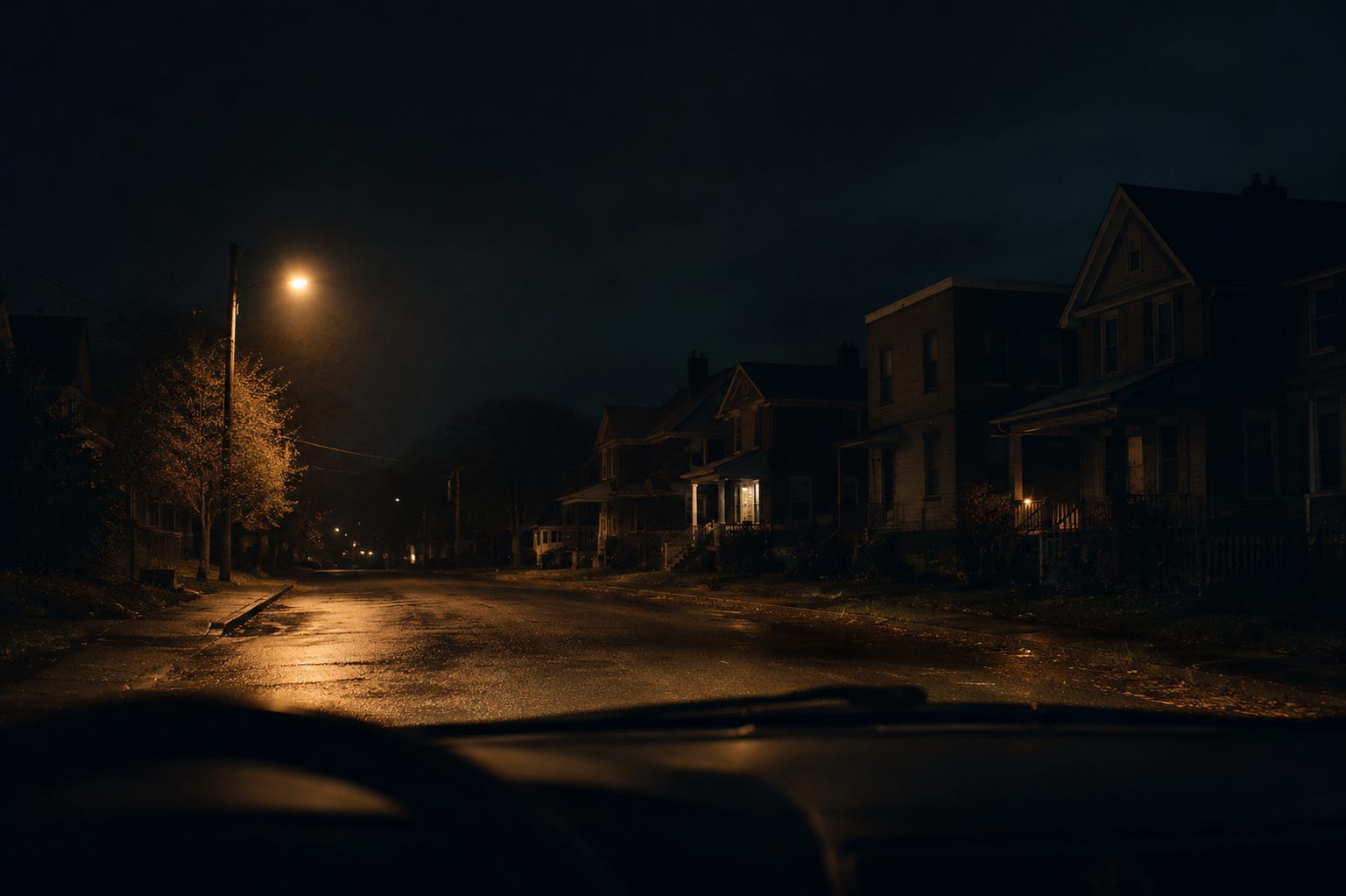
It was after ten when we pulled up to the stop sign, and the ice cream truck was still running. Bell going. That tinny little song looping into the dark. A handful of men gathered around it, the way men gather around something that isn’t selling ice cream.
Nobody buys a popsicle at ten-thirty at night. We all knew what the truck was.
My team member was in the passenger seat. I’d driven her that night myself, because the house we cared for kept a physical key. No smart lock, no lockbox. The owners had watched both get forced open before, so we did it the old way, which meant only certain people could cover the visits, and that night the person was her, and the driver was me.
We’d fed the husky and the cat. We were leaving. A few stop signs between us and the main road, past the rough houses and the occasional new build dropped onto a leveled lot, because the neighborhood was coming up even if it hadn’t arrived.
We stopped at the sign. And the man at the center of the group looked right at me.
He raised his hand. Pointed his finger at me like a gun. And pulled the trigger. I could see the real one at his waistband. He didn’t need it, and he wanted me to know it.
I felt her go still beside me. She was holding her breath.
My pulse went up. I want to be honest about that, because the composure people remember was never the absence of fear. It was the decision not to spend it where he could see it. I held his eyes. I gave him a small nod, his finger still pointed at me, and I pulled through the intersection at the same speed I’d have used on any other street in the city.
Here is what I knew in that second, and what took me years to fully understand.
If I showed him fear, my team would pay for it. Not me. Them. That truck would be there next week and the week after. My people would be back on that street, alone, with a key in their pocket and a dog to walk. Whatever he read off my face at that stop sign became the conditions they’d operate in every time they returned.
So I didn’t give him anything to read.
When you are the one in the car, your composure is not a personality trait. It is infrastructure. It is the thing standing between your team and the dark, and in that moment it was the only thing I had.
But here is the truth I’d resist if I were a worse writer: nerve got us through that night, and nerve is not a plan.
That family was already a premium account. They paid us well above the standard rate, because they had called everyone else and everyone else said no. Too far. Or really, too far into the wrong part of town. We were the service that would go where others wouldn’t, and we charged for it, and we showed up.
So this was never a story about underpricing risk. We’d priced it. We’d chosen it with our eyes open.
And I still ended up at that stop sign with someone holding her breath next to me.
That’s the part the rate can’t touch. You can charge correctly for a hard job. You can read a gap in the market that nobody else will serve and build real revenue out of it. And none of that buys down the second a man points his finger at you like a gun. Some risk shows up on the invoice. Some risk the owner just absorbs, quietly, in the driver’s seat, and never bills for.
When you’re small, you take all of it, because you can’t say no to revenue.
In DC that meant a business that ran close to around the clock. Military clients up at four-thirty wanting a walk before the day started. Medical teams coming off overnight shifts wanting a walk at one in the morning. We said yes to every bit of it. When you’re building, every yes feels like survival.
Then you grow. You get enough volume that you’re no longer scrambling to fill a schedule, you’re building one. And the day you can build the schedule is the day you have to get good at the math.
Because that one a.m. visit never cost what the invoice said. Picture it as a line item. The walk pays maybe twenty-five dollars. Against it: forty minutes of round-trip drive time across a city that isn’t friendly at that hour, a team member alone on a dark street, and a key that only three people in the entire company were cleared to carry, which meant one of those three had to be awake and available or the visit didn’t happen at all. The revenue was real. The margin, once you counted what it actually took, was a rounding error sitting on top of a risk I couldn’t price.
When you finally run the numbers like that, the math says what the adrenaline had been telling you for two years.
So we set the window. Standard visits started around eight in the morning. The last one went out no later than ten at night, so our people were off the street by eleven.
We didn’t kill the off-hours work. We priced it.
The around-the-clock service became its own tier, a concierge offering at a real premium, and it ran where the premium made sense. Dignitaries traveling through the city, staying in the four and five-star hotels, where the rate finally matched the reality of the hour. Same one a.m. on the clock. Completely different economics.
The hour was never the problem. Charging an ordinary rate for an extraordinary risk was the problem.
If you run a service business, you already have a stop sign somewhere in your operation. A client you take at hours you shouldn’t. A route you’d never want your own kid driving alone. A margin you’ve quietly decided to eat because the work is too hard to say no to and you haven’t done the math that would force the conversation.
I think about that stop sign more than I expected to. Not because of him. Because of her. The held breath in the seat next to me is the whole lesson. My nerve protected her that night, and I’m glad I had it. But you cannot run a business on the assumption that the owner will always be in the car, always be calm, always be there to stare down the thing in the dark.
Nerve gets you through the moment. Structure gets you through the business.
The owners who last are the ones who understand that their own steadiness, however real, is a bridge and not a foundation. You hold the line yourself for as long as you have to. Then you build the systems, set the hours, price the risk, and put real protocols underneath your people, so their safety never again comes down to whether one person in a car happened to keep her face still.
You hold the line tonight. You build the system so nobody has to hold it alone tomorrow.
If this resonated, subscribe to The Jenn Files. I write about business, money, resilience, and grit — cutting through the noise so you can build something that can’t be broken.
What’s the stop sign in your operation — the risk you’ve been absorbing on nerve because the math would force a conversation you don’t want to have?